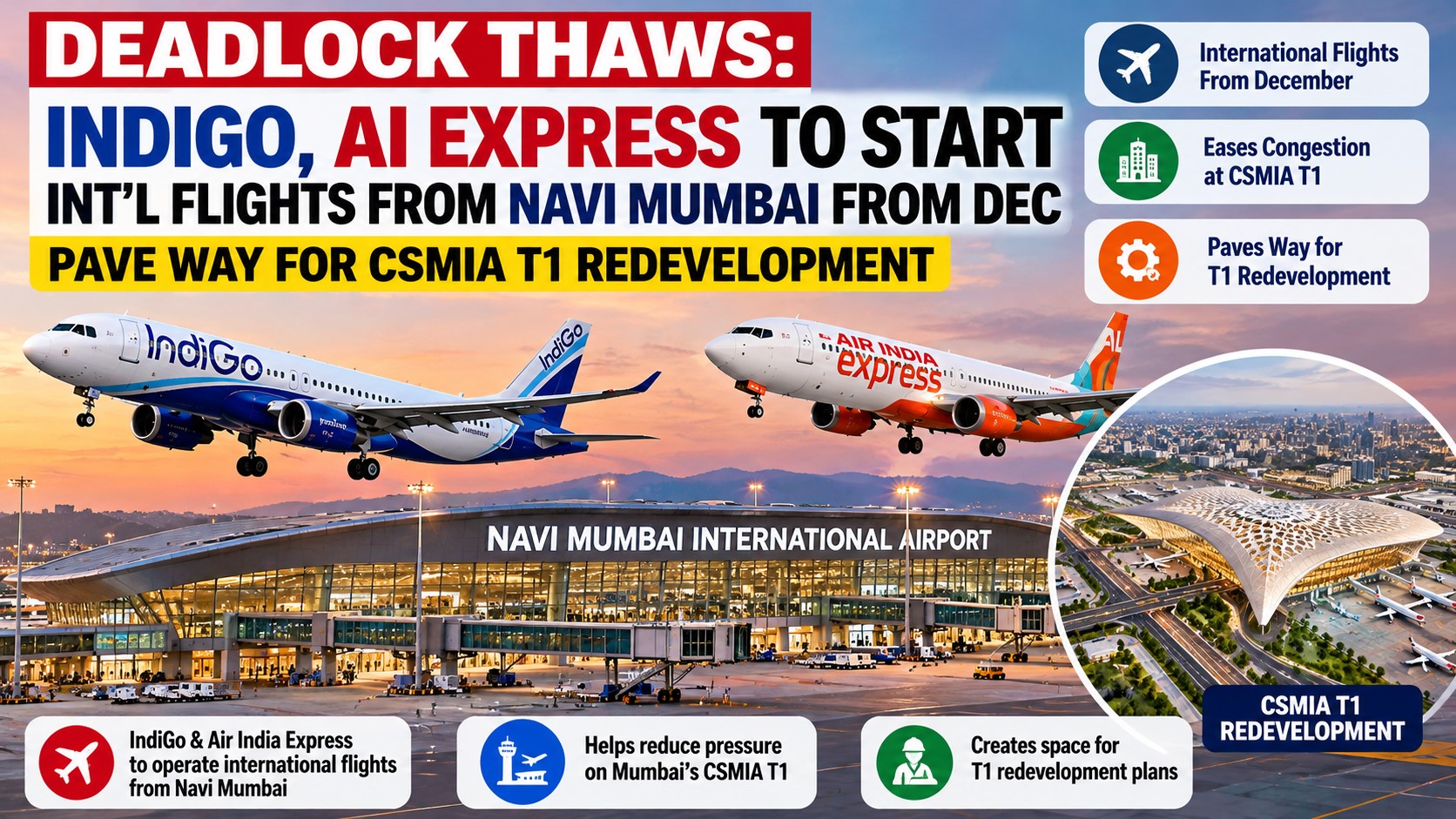
The prolonged standoff over shifting airline operations from Mumbai’s Chhatrapati Shivaji Maharaj International Airport (CSMIA) to the new Navi Mumbai International Airport (NMIA) has begun to ease, with IndiGo and the Air India Group agreeing to transfer selected flight services in phases.
The agreement marks an important step towards redistributing air traffic between Mumbai’s two airports and creating the operational capacity needed for the redevelopment of CSMIA’s Terminal 1 (T1). The transition is expected to begin in December 2026 for selected Air India Express operations, while IndiGo plans to start its international services from Navi Mumbai in February 2027.
The two airlines’ announcements follow weeks of disagreements between airport authorities and airlines over the proposed relocation of international flights, operational feasibility and the impact on passengers.
Air India Express to Begin Operations in December
According to the Air India Group’s announcement, Air India Express plans to operate four daily domestic flights from Navi Mumbai International Airport beginning in December 2026.
The airline also plans to introduce services to Kuwait, subject to the necessary approvals, and shift existing Oman services to NMIA from January 2027. It will progressively transition additional international services to the new airport.
The destinations included in the Air India Express transition plan are Jeddah, Riyadh, Dammam, Doha, Muscat and Sharjah. The phased transfer is intended to strengthen the airline’s operations at Navi Mumbai while supporting the broader airport redevelopment programme.
The final schedule will depend on operational coordination and applicable approvals.
IndiGo Plans 12 Daily International Departures
IndiGo and Adani Airport Holdings Limited (AAHL) have announced plans to begin international operations from Navi Mumbai in February 2027.
Under the proposed transition, IndiGo plans to move 12 daily international departures from CSMIA to NMIA. The services currently connect Mumbai with destinations including Bahrain, Riyadh, Dammam, Jeddah, Madinah, Kuwait, Ras Al Khaimah, Fujairah, Muscat, Dhaka and Jakarta.
IndiGo also plans to introduce a daily service to Kathmandu from Navi Mumbai, expanding the airport’s international connectivity. The airline intends to shift the domestic connections required to support these international services, helping passengers make onward connections through NMIA.
The transition is expected to take place progressively between February and July 2027, subject to final coordination and operating approvals. IndiGo has also indicated that the move will create room for further international expansion across Asia, Africa and Europe.
Why Is CSMIA Terminal 1 Being Redeveloped?
The redevelopment of CSMIA Terminal 1 is a major factor behind the proposed relocation of flights.
The airport operator has been seeking to redistribute a portion of the traffic handled by Mumbai’s existing airport so that redevelopment work can proceed while maintaining operations as efficiently as possible.
The planned redevelopment is expected to increase Terminal 1’s annual passenger-handling capacity from approximately 15 million to 20 million. The project is intended to modernise facilities and improve the airport’s ability to accommodate passenger growth.
Moving selected flights to NMIA would create additional capacity at CSMIA during the redevelopment process. It would also help reduce pressure on an airport that already handles substantial domestic and international traffic.
What Caused the Deadlock?
The proposed flight transfers had faced resistance from airline representatives, who raised concerns about the allocation of airport slots, operational planning, passenger convenience and the evidence supporting the proposed capacity reductions.
Airport authorities had proposed shifting a portion of international operations from CSMIA to NMIA. Airlines questioned whether the changes could be implemented smoothly, particularly where existing schedules, aircraft deployment and domestic-to-international connections were concerned.
The disagreement also involved the proposed reduction or relocation of international departure slots at CSMIA. The plan affected multiple airlines, not just IndiGo and Air India Express.
Government intervention helped bring the parties back to discussions, and the latest announcements indicate progress towards a phased transition. However, the broader reallocation of operations and the positions of other airlines remain important parts of the ongoing process.
How Will the Shift Affect Passengers?
For passengers, the most immediate impact will be the need to check departure airports carefully when booking or travelling.
Flights currently operating from CSMIA may move to NMIA according to the final schedules announced by the airlines. Travellers should therefore verify their ticket details, airport codes, departure terminal and transport arrangements before leaving for the airport.
The two airports serve the Mumbai Metropolitan Region but are located in different areas. A change in departure airport could affect journey times, ground transportation costs and connections, especially for passengers travelling from central or western Mumbai.
At the same time, the expansion of NMIA is expected to provide more capacity for future services and additional options for travellers across the region.
Airlines are expected to publish final transition dates and revised schedules as operational arrangements are completed.
Navi Mumbai Airport's Growing Role
Navi Mumbai International Airport is being developed as a second major aviation gateway for the Mumbai Metropolitan Region.
The planned transfer of domestic and international services will help establish a dual-airport system in which flight operations are distributed between CSMIA and NMIA. Such a model is intended to accommodate future passenger growth while allowing the existing airport to modernise its infrastructure.
For airlines, the new airport offers opportunities to expand services and establish additional connections. For the wider region, improved airport capacity could support tourism, business travel, trade and logistics.
The success of this transition will depend on effective coordination between airport operators, airlines, regulators and ground-transport providers.
What Happens Next?
The coming months will be important for the implementation of the relocation plan.
Air India Express is preparing to introduce selected services from December 2026, followed by planned international operations and route transfers in 2027. IndiGo is targeting February 2027 for the start of its international operations from NMIA, with its network expansion expected to continue through July.
The precise dates and schedules remain subject to final operational coordination and the necessary approvals. Other airlines’ participation and the final arrangements for CSMIA’s Terminal 1 redevelopment will also influence the overall transition.
The agreement by IndiGo and the Air India Group represents a significant breakthrough in the airport capacity dispute. If implemented as planned, the phased relocation could help ease pressure on Mumbai’s existing airport, facilitate Terminal 1 redevelopment and strengthen Navi Mumbai’s position as a growing international aviation hub.
Source note: This report is based on announcements by Air India Group, IndiGo and Adani Airport Holdings Limited, along with published reporting on the airport transition. Schedules and route changes may be updated as approvals and operational arrangements are finalised.
Published by DIT Media Network
Comments (0)
No comments yet. Be the first to comment.