
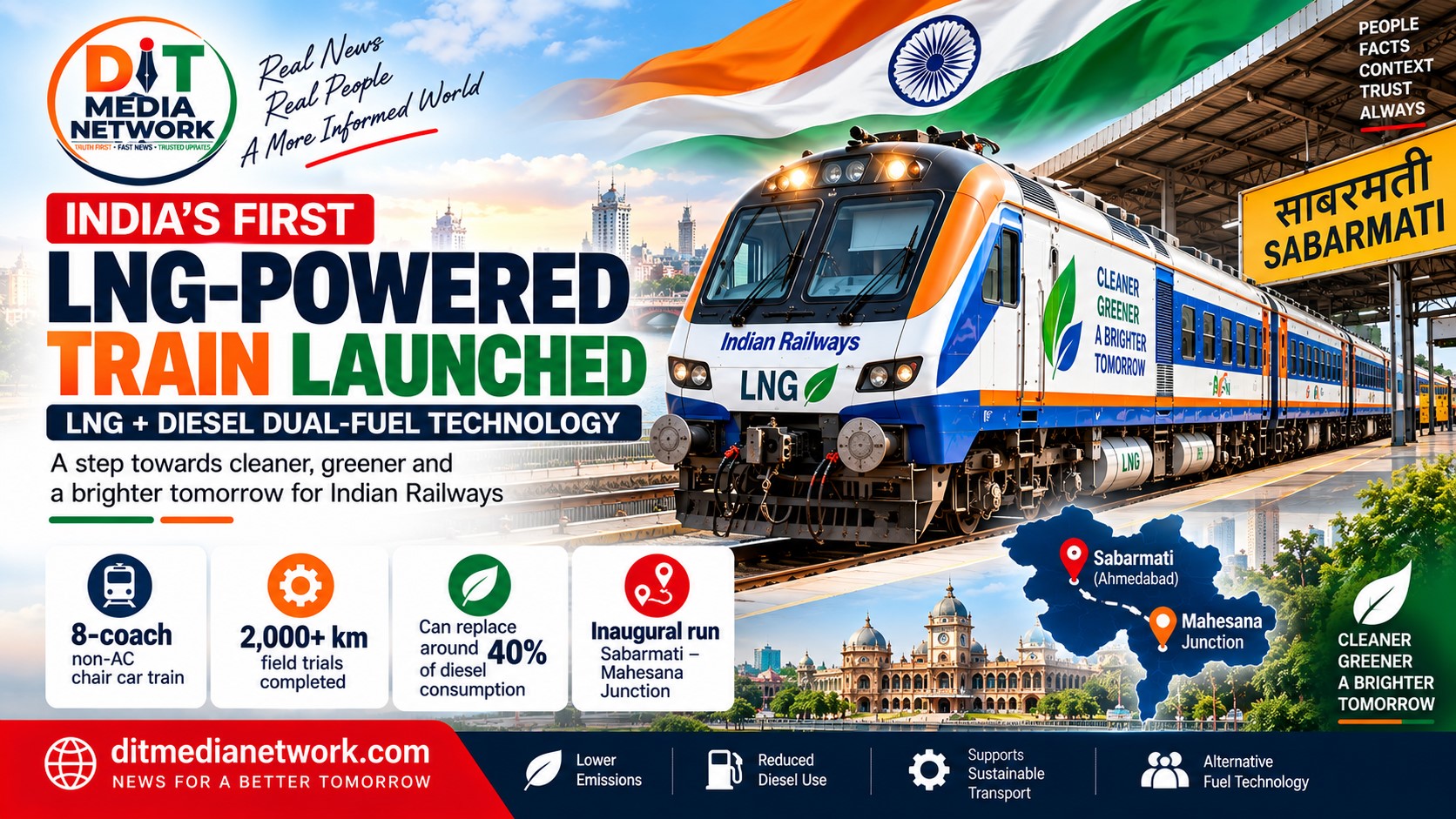
Ahmedabad, September 28, 2026: India has introduced its first LNG-diesel dual-fuel train, marking a new step in Indian Railways’ efforts to explore alternative fuels and reduce dependence on diesel.
The train was flagged off from Sabarmati Railway Station in Ahmedabad, Gujarat, on September 27, 2026, by Union Home and Cooperation Minister Amit Shah. Gujarat Chief Minister Bhupendra Patel and other officials were present at the launch.
Train Uses LNG and Diesel
The new train uses a dual-fuel system, allowing its engines to operate on both liquefied natural gas (LNG) and diesel. Two 1,400-horsepower Driving Power Cars (DPCs) at the Sabarmati Integrated Coaching Depot have been converted for the LNG-diesel system.
According to railway information reported by The Indian Express, LNG can replace around 40% of diesel consumption under the system. More than 2,000 kilometres of field trials were completed to assess the performance and reliability of the converted power cars before the inaugural operation.
Sabarmati-Mahesana Inaugural Run
The first operational run is between Sabarmati and Mahesana Junction, covering approximately 62 kilometres. The train is an eight-coach, non-AC chair-car train.
Railway officials said the final regular route for the LNG-powered train has not yet been announced. The inaugural journey is therefore separate from any final decision about its long-term route.
Focus on Lower Diesel Consumption
The dual-fuel technology is designed to allow the train to continue operating even when LNG is not available, because the engine can switch between LNG and diesel.
Indian Railways is exploring the technology as a way to reduce diesel consumption and emissions while testing the potential of alternative fuels in railway operations. News On AIR described the launch as part of the railways' shift towards cleaner energy.
More Railway Projects Launched in Gujarat
The LNG train was launched alongside several other railway projects in Gujarat. According to the Press Information Bureau, projects worth ₹1,472 crore were inaugurated or launched during the programme.
These included a WAG-12 locomotive maintenance shed, railway infrastructure improvements and other safety and signalling-related projects.
The WAG-12 maintenance facility is intended to support maintenance of high-horsepower electric locomotives used for freight operations. Other projects announced during the programme included automatic signalling and the expansion/doubling of railway infrastructure in the region.
India’s Growing Alternative-Fuel Railway Programme
The LNG train follows India's introduction of other alternative-fuel railway technologies. Indian Railways launched its first hydrogen-powered train earlier in 2026, making the LNG initiative another experiment with non-conventional fuels for railway operations.
The LNG project will provide operational experience with dual-fuel technology and could help assess its potential for reducing diesel consumption in suitable railway services.
Key Facts
| Feature | Details |
|---|---|
| Train technology | LNG + Diesel dual fuel |
| Launch location | Sabarmati, Ahmedabad, Gujarat |
| Launch date | September 27, 2026 |
| Inaugural route | Sabarmati - Mahesana Junction |
| Coaches | 8 non-AC chair-car coaches |
| Power cars converted | 2 |
| Power per DPC | 1,400 HP |
| Field trials | More than 2,000 km |
| Potential LNG substitution | Around 40% of diesel consumption |
| Regular route | Yet to be finalised |
What This Means for Indian Railways
The introduction of the LNG-diesel train gives Indian Railways an opportunity to evaluate alternative-fuel technology under actual operating conditions. Its performance, fuel savings, maintenance requirements and emissions profile will be important factors in determining how widely similar technology could be used in the future.
The project also comes as Indian Railways continues to expand electrification and introduce newer technologies aimed at improving railway efficiency, safety and sustainability.
Comments (0)
No comments yet. Be the first to comment.